

Pacifism is Selfish

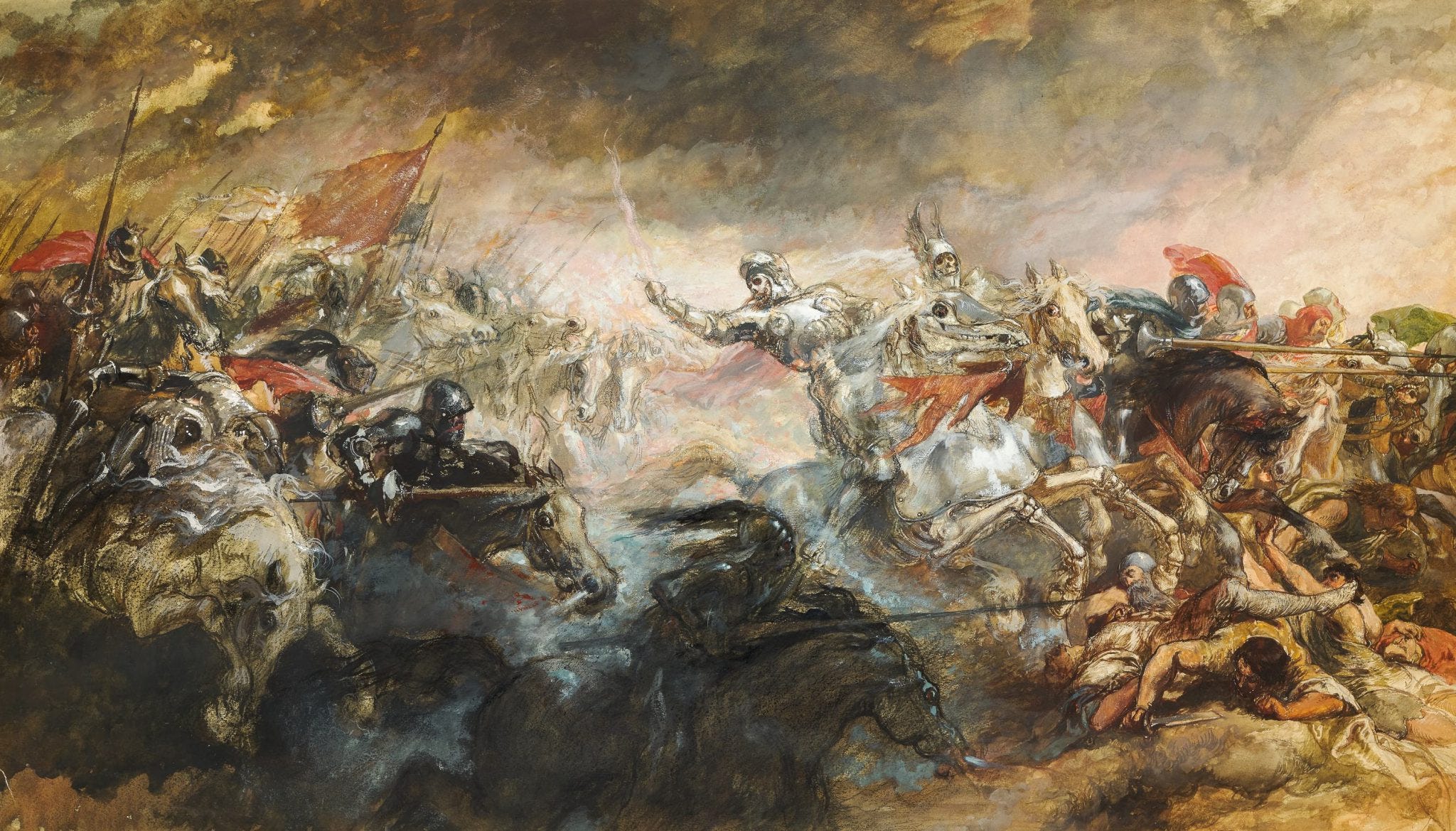
“Rescue those being led away to death; hold back those staggering toward slaughter.”
Proverbs 24:11
Judge not. No two words have been so weaponized to calamity more than the introductory words of Matthew 7. The chapter has - depending on translation - over six hundred words, yet modern theology has built its foundation solely on the first two. The words per se are true, as Our Lord has commanded. In its proper employment, “judge not” is a reminder to all: the same measure with which we judge others will be used to judge us, too. It is a frightful warning against hypocrisy and, more importantly, a warning against the usurpation of Jesus Christ’s role as the exclusive judge of humanity. Yet modernity has no intention of obedience to God; much less loyalty to His truth. Rather than a fruitful warning, modernity has weaponized “judge not” to subvert the mission of the Gospel. In modernity, “judge not” has a paralytic effect. Any crime, misdeed, or malevolence is taught to be meet with a blind eye; even the mere perception of evil is supposedly sinful. Today, “judge not” is not a warning against hypocrisy, it is a blindfold so that evil can spread unnoticed.
This modern heresy has had profound effects on the way we view life. Most are aware of its obvious societal effects; turning a blind eye is actually a tacit approval of evil, and thus an endorsement. Many, however, don’t consider how much it atomizes society. An individual who accepts the modernist interpretation of “judge not” logically concludes that sole realm of concern is with himself. Again, this alone is not heretical per se. It could be interpreted as a practical application of the Jesus Prayer, “Lord Jesus Christ, have mercy upon me, a sinner,” or St. Paul’s description of himself as “chief among sinners.” Yet again, modernist theology removes Christ from the equation, thus removing true meaning. Consequently, the modernist is concerned only with himself not out of humility, but from a disregard for his brother.
When such thinking is applied practically, it manifests as pacifism. Of course, to be peaceful is to follow God’s commandments. “Blessed are the peacemakers, for they shall be called sons of God,” says Jesus in Matthew 5:9. To be pacifistic, however, is another thing altogether. The same man who regards it as sinful to recognize evil for what it truly is consequently believes that fighting against evil is unthinkable. For pacifists, the idea of fighting is evil not because violence is wrong, but rather it is evil because it is the physical enforcement of judgment. As an example, to stop a rapist in the act violates pacifism because it would force the pacifist to inflict judgment on the rapist; to recognize that the rapist is performing a evil act, and condemn his actions by use of force.
As such, pacifism is selfish. While pacifists try to justify their own inaction as some sort of quasi-Christian love for others, the reality is just the opposite. Pacifism is simply a strategy to keep one’s own hands clean, to not dirty themselves with the struggle of others, and to maintain plausible deniability as to their own kindness. The repercussions of the pacifist heresy are as widespread as they are profound. In this post, I dissect how pacifism destroys law and order, emasculates Christianity, and tricks believers into retreating from the world in order to care for themselves.
DISCLAIMER: Insofar as pacifism is a heresy, so too is offensive militarism. Wrath, like judgment, is God’s alone.
The Psychology of Pacifism

In Ivan Ilyin’s On the Resistance to Evil by Force, he critiques Count Leo Tolstoy’s pacifist Christianity through a series of psychological and philosophical arguments. In doing so, Ilyin first diagnoses the pacifist mindset both internally to himself and externally towards the world. What follows is a psychological exposé on the pacifist interpretation of “violence,” a term so watered-down and abused that it had come to mean nothing more than mere interaction.
According to Ilyin, the pacifist heresy is born from a strong conception of good vs. evil, and internal vs. external. For the pacifist, only what is internal to oneself can be dealt with; such personal concerns are “good.” Therefore, any external concerns are, by definition, “evil.” Tolstoy even went as far as to say:
“the external world is a world of sin, sadness and strife… it abides in evil and is full of offence [sic]… [and thus] contrary to the law of morality.”
That the external world is full of sin should not come as a surprise. Pacifists are certainly not the only people to realize that the world is a place full of lying, scheming, and killing. That much is true. The pacifist heresy, however, arises in where they see their place in that world. Ilyin explains that the pacifist cannot accept this “world of discord,” and no matter how one attempts to participate in it, “the struggle will always remain a struggle.” Therefore, for Christian pacifists, any attempt to help, change, or participate in the world is inherently sinful, without the possibility of Christian morality. Consequently, since the external world is deeply immoral, the Christian pacifist’s solution is to proclaim a life of asceticism and non-resistance.
Here is the most important thing to understand. Yes, the Christian pacifist will always prefer self-sacrifice to personal gain. But this impulse is not for the sake of saving his beloved, but rather for the sake of saving his own righteousness. This is because pacifism sees all interactions with the outside world as inherently immoral. Even further, they believe that any attempt to influence another person - either mentally or physically - is a form of violence. Thus, the pacifist accepts evil because resistance is inherently immoral. Ilyin explains how this manifests in real life:
“All [the pacifist] can do in defense of the neighbor under threat of being killed is to offer the villain to be content with killing [himself]; if he is not interested… then it remains for [the pacifist] to see in this “the will of God.”
Preventing a villain from raping a girl would be to enter into the external world and violently impose your own will on the rapist. This, for the pacifist, is a worse crime than rape, itself. If they let the rapist rape the girl, they chalk it up to “God’s will,” justifying their own inaction as Biblical meekness and being content with keeping their hands clean. After all, it wasn’t them who raped the girl; they stayed pure and non-violent! The most a pacifist can offer the girl is his pity; thoughts and prayers are much preferred to heroic action.
As such, violence takes on a brand new definition. Any interaction with another person’s will - any attempt to help, to prevent, to promote - is to impose oneself over that person. A pacifist can only be concerned with himself and his own sins. Any and all considerations external to himself is thus the realm of God; any attempt to change the will of God is therefore sinful.
Anarcho-Tyranny & Inverted Morality
So what is the pacifist’s answer to societal evils? Given that the external world is sinful, and that any attempt to change the world is violence, the answer is escapism. As Ilyin explains, “the spiritual necessity and function of legal consciousness eludes [the pacifist] completely.” Since laws regulate the behavior of others, they are a unique evil. Pacifists believe any state which claims to punish murderers, robbers, and crooks is instead using systemic violence against such persons. Therefore, “the sympathies of the [pacifist] are entirely on the side of these [criminals],” not the state. Patriotic servants are regarded as serving systemic violence because any promotion of law is the promotion of violence. As an extension, military service, institutional establishments, money, and even societal norms are disregarded in a flood of moral indignation; they all serve - in one way or another - the violent attempt to impose one’s will on another.
The inevitable conclusion from pacifism “is the denial of the motherland, its being, its state, and its defense.” To have a common identity or common values logically means the exclusion others, which is also a form of violence. Therefore, this self-absorbed obsession with maintaining pure and non-judgmental leads them to embrace the “victims” of systemic violence. As Ilyin explains, the pacifist believes:
“It is necessary to give to the [thief] all that he takes away; it is necessary to feel sorry for him because he does not have on his own, and invite him to relocate and live among us in love and brotherhood. For there is nothing on earth that is worth defending with his life or death, nothing which it is worth killing or dying.”
Leon Trotsky, a student of Tolstoyan Pacifism, summarized the ideology of Christian Pacifism in his “Five Programmatic Theses.” There, he writes that:
It is not some iron sociological laws that produces the enslavement of people, but legal codes.
Modern slavery rests on three statutes: land, taxes, and property.
Not just the Russian state, but every state is an institution for committing violence…
Genuine social progress is attained only through religious and moral self-perception.
To get rid of states it is not necessary to fight against them with external means. All that is needed is not to take part in them and not to support them."
If this insane anarcho-tyrannic ideology wasn’t bad enough on its own, consider the implications pacifism has on family. Given that pacifism places a greater emphasis on the well-being of others rather than the interests of the self, it creates an idol out of equality. Tolstoy thus remarks that “the birth of children would be permissible [for a pacifist] only in the event that he saw that ‘all existing children were provided for.’” It should come as no surprise, then, when the most “civilized and progressive” countries have the lowest birth rates. Pacifist theology has inverted morality to convince people that having babies is selfish; that we must be more concerned with starving orphans in Africa, for example, than the continuation of our own people. Since pacifist philosophy rejects any distinction between any peoples, the love you give to your would-be child is love that could have been given to a foreign child who “needs it more.” You, child-having couples, are therefore selfish and sinful.
Pacifism & Society

It is an understatement to say that pacifism has had profound effects on society, American society in particular. It’s likewise important to note that there are many who claim to reject pacifism, yet proudly champion a cause that directly descends from pacifist psychology. In the American context, pacifism has birthed two false gods: Equality and Liberty. Equality being the false god of the American left, and Liberty being the false god of the American right. While equality and liberty are not particularly bad concepts on their own, the pacifist heresy from which their modern worship derive informs followers to worship them above even God, Himself.
Equality: The False God of the Left
To explain what I mean, consider the modern treatment of Equality. As explained above, the pacifist is concerned with himself not out of genuine Christian introspection, but rather from a disregard for the outside world. If interacting with the outside world in order to change or influence it is violence, then any societal distinction is violence, too. This is because pacifists view distinctions as a logical extension of providing for oneself; out-groups necessitate the existence of in-groups, and in-groups are prideful and self-serving. As a result, there must be equality in all things, across all peoples, across all times. Any system that allows for such distinctions is thus deemed to be systemically violent.
We hear that term a lot nowadays, as well as its various off-shoots: systemic racism, systemic inequality, or even structural violence. Of course, it’s one thing for a non-Christian leftist to label society as systemically violent. They have no God, no objective morality, and thus every reason to want to destroy pre-existing civilizations. It is a whole other thing, however, for a Christian leftist to bemoan society as systemically violent. Here, one can clearly see how Christian pacifism warps the mind. Inasmuch as distinctions are violent, so too are borders, social classes, the justice system, and even biology, itself.
To the illegal immigrant, they say “Jesus was a refugee, too! There is no Jew or Greek, anymore!” Of course, these things are true in their proper context. The problem is that Christian pacifists cannot accept the state, much less recognize that a state can have needs. If the state is an engine of systemic violence - which pacifism abhors - then the idea that a state can only take in so many immigrants at any given time is completely lost on them. They cannot grasp the concept. As such, there can never be a limit to the amount of immigrants pouring in, for any reason. Anything otherwise would be a violent imposition of your will on theirs. After all, to the pacifist, the fact that they are coming at all is a question of the outside world, which - as explained above - is “God’s will.”
This same logic extends to all areas of life. For example, barring homosexual marriage is to judge their concept of marriage as sinful, and judgment is violence. As such, the Gospel becomes twisted. Rather than recognize that Jesus Christ went to dine with tax collectors and prostitutes in order to lovingly reproach them to change their ways, they see it as a tacit endorsement of all lifestyles without change. For the leftist, Jesus Christ’s true purpose was not salvation, but equality. To tell the sinner that he must repent is to make a value judgment about them; a violent distinction. To punish the criminal for his crime is to judge them; the leftist pacifist would rather we look inward, instead. In this regard, leftist (in)action is self-serving. The left’s pacifistic obsession with equality allows them to keep their hands clean of “violent” things like enforcing rules, upholding social norms, and even strict obeisance to God. They rest easy at night, priding themselves on the fact that they did not dare offend anyone, directly or systemically. They do not realize, however, that “we must not mind insulting men, if by respecting them, we offend God.” (St. John Chrysostom).
Liberty: The False God of the Right
There is nowhere that the pacifist heresy can be seen more clearly, however, than the Liberty-worshipping Right. While the Equality-worshipping Left are students of Christian pacifism’s more structural/pseudo-psychological teachings, the Liberty-obsessed Right are far more direct. They may - and often do - disagree profoundly with the Left on policy and morality, but would never dare impose those views beyond the confines of their own homes.
Take the modern Libertarian Party, for example. Libertarians have always been known to be anti-big government, for better or for worse. I certainly would not dare to deride every policy position they hold, but an extreme following of libertarianism logically leads to pacifistic approval of societal ills. Many libertarians have openly embraced the defense of trans “rights,” the exercise and promotion of pagan religions, and drug use, all in the name of liberty. While the vast majority would not engage in such heinous activities themselves, the Liberty-worshipping Right would fight for people’s legal and social approval to do so. Why? It’s due to their pacifist-informed ideology wherein resisting villainy is a greater evil; promoting God’s truth offends the false god of Liberty.
This framework has also recently manifested itself in the more traditionally-minded Christians. Such Christians are a far cry from libertarians in terms of political philosophy, but a small subset are prone to the same pacifistic errors. The particular mode in which pacifism rears its head for these Christians is the impulse to escape society, run away, and live an ascetic life in the mountains or desert. To be clear, I am neither condemning nor criticizing such lifestyles. To live an ascetic lifestyle away from the temptations of civilization is not only a wonderful, wholesome thing, but one steeped in Christian tradition. The problem, however, is when such Christians criticize those who do not escape society, in kind.
In the same manner by which libertarians recognize the sin around them, yet dare not intervene, such Christians believe the only way to deal with a fallen world is to escape it. Again, this is certainly not wrong per se. As a Texan, I definitely understand the value of removing oneself from degenerate cities and spending time with the land, and with Our God. However, the small niche who condemn Christians that remain in society do so out of a pacifistic surrender. That our society grows more sinful is true, and that our government grows more corrupt is also true, yet such people act as if there is nothing to be done about it. In their eyes, to fight against the spread of sin is a fruitless endeavor, or worse, an exercise of pride. “God’s Kingdom is not an earthly kingdom,” they remind us. Again, this is true, but its effect is to surrender to sin and the spread of darkness. There is a danger of selfishness in this pacifism. I must reiterate, that homesteading or moving to the country is not wrong at all. However, the Christian pacifist justifies his own inaction because he keeps himself “holy” and “untouched" by the degeneracy of the modern world, unlike the one who lives amongst the sinful; they who “dirty themselves” by fighting against evil. For such people, to resist evil and fight for a better future is a prideful, wrathful exercise. It is therefore better to escape, and thus surrender to societal evil, paying no mind to the next generations who will live under its rule. As a result, the path of non-resistance serves only their own interests: to keep their hands clean from “violence.”
What Christianity Actually Teaches

On War
It must said at the outset that this paper is not advocating for Christianity as some sort of jihad-based warrior cult. Our Lord Jesus Christ Himself declared that perfect love is to love our enemies, to pray for those who persecute us, and to do good to those that hate us (Matthew 5:43-44). In this manner, the Church explicitly teaches that war is inherently evil, and as such, there can never be a “holy war.” In Romans 15:33, St. Paul reminds us that our God is the “God of peace.” Consequently, war - as the culmination of chaos and true violence - is separation from God. As such, we should be keen to remember that no earthly empire nor any great conquest will account for our eternal salvation. After all, God’s “kingdom is not of this world.” (John 13:34).
However, while we are not of the world, we are indeed in the world (John 17:14-18). War is unfortunately an inescapable reality. St. Athanasius the Great thus wrote:
"Although one is not supposed to kill, the killing of the enemy in time of war is both a lawful and praiseworthy thing. This is why we consider individuals who have distinguished themselves in war as being worthy of great honors, and indeed public monuments are set up to celebrate their achievements. It is evident, therefore, that at one particular time, and under one set of circumstances, an act is not permissible, but when time and circumstances are right, it is both allowed and condoned.” (Letter to Amun; XLVIII).
Similarly, St. Basil the Great writes:
"Our Fathers did not consider the killings committed in the course of wars to be classifiable as murders at all, on the score, it seems to me, of allowing a pardon to men fighting in defense of sobriety and piety. Perhaps, though, it might be advisable to refuse them communion for three years, on the ground that they are not clean-handed." (Canon 13 of St. Basil).
Clearly, one can see that, while reprehensible, the Church Fathers recognize war as an inevitable part of life. Inasmuch as war is always evil, it oftentimes must be fought in order to prevent a greater evil. In this manner, war-fighting is a “necessary evil.” The last sentence of St. Basil’s Canon 13 is thus enlightening. Soldiers who kill in war are refused communion for three years (a practice still more-or-less maintained in the Orthodox Church) not as a punishment, but as a mercy. Their participation and advancement of an inherent evil - war and killing - therefore requires a period of repentance and spiritual healing before approaching the Holy Chalice. In a similar manner, priests are forbidden from taking up arms in a war due to war being a worldly enterprise. Canon 83 of the Holy Apostles thus reminds us of Jesus’ words in Matthew 22, “render unto Caesar the things that are Caesar’s, and unto God the things that are God’s.” The implication being that war is for the world, priests are for God.
Yet, participation in war cannot solely be viewed in a “necessary evil” light. After all, John 15:13 reminds us: “greater love hath no man than this, to lay down his life for his friends.” Likewise, while not a universally held opinion, St. Athanasius goes as far as to say that such warriors are not only performing a duty, but also worthy of “great honors” and “public monuments… to celebrate their achievements.”
One must also consider the civilizational aspect of war. Insofar as evil may presents itself as a societal force, the necessity of resistance becomes imminent. This idea is perfectly encapsulated by St. Kosmas the Aetolian, an 18th century Saint living in Ottoman-occupied Albania and Greece. St. Kosmas dedicated his life to reinvigorate Christianity in Greece’s rural areas; areas that had gone centuries without churches, priests, and thus without Christianity. After building over 200 Christian schools, churches, and charities, the land’s Muslim rulers began to hunt him down and execute him. St. Kosmas’ entire mission was to breathe life back into Christianity in Greece; an area long-stifled by Muslim domination. Before giving up his spirit to the Lord, St. Kosmas prophesied:
"They will ask for your rifles. Retain two. Give one and keep the other. A single rifle will save a hundred souls."
Some Church scholars have held this quote to be in exclusive reference to spiritual warfare, yet many others recognize it to be well in-line with St. Kosmas’ larger anti-Ottoman resistance message. After all, St. Kosmas is credited as playing a major role in influencing Greece’s War of Independence some 40 years later. In any case, a clear pattern emerges. The oppression of anti-Christian forces onto a Christian populace will result in spiritual destitution. The people of rural Greece and Albania had gone generations without any Church, priest, or Bible. In this manner, they were spiritually starving. As a result, there existed a necessity to resist evil, to fight against oppression, and ultimately, to win freedom for a people who’d suffered from a forced anti-Christian lifestyle for so long.
However, this is not to say that war is only justified if you are serving an explicitly Christian state. Consider the life of St. Mercurius. St. Mercurius was a soldier in the Roman army during the reigns of Decius and Valerian, overtly anti-Christian emperors. At that time, a decree was issued obligating the universal worship of pagan gods under threat of death for non-compliant Christians. Simultaneously, however, Rome was beset with barbarian invasions. Emperor Decius thus went to war with a large army, with the Christian St. Mercurius serving as an officer. During a battle, the Archangel Michael appeared to St. Mercurius and offered him a divine sword, saying,
“Fear not, Mercurius. Go forth bravely against the enemy, and when you are victorious, do not forget the Lord your God.”
Thus, the holy warrior cut through the barbarians, even killing their king. In celebration of his feats, St. Mercurius was subsequently promoted to Commander of the Roman Army. This celebration was not to last, however, as he was later martyred upon publicly revealing his faith in Christ and dedication of the victory to our Lord. Through his martyrdom, thousands of pagans Romans converted as witnesses to God’s greatness.
St. Mercurius’ military exploits tell us a great deal about Christianity and war. By God’s power, St. Mercurius became a master of war, earning him influence and renown. Through this was God’s light spread unto the empire; war was a means to the most important and holy of ends. God did not command St. Mercurius to be pacifistic, nor even renounce his non-Christian empire. God can use anything - even warfare - to achieve His purposes.
In sum, one will find that the Christian perspective on war is one of painful realism. It should never be sought out or stoked, but our participation in it may not only be a temporal necessity, but a civilization-saving one, too. The pacifist rejects conflict, looking out for his own spiritual cleanliness. He cares not if a barbaric horde take his city, his country, or himself; only that he maintains his clean hands. Christianity, however, asks you to love your family, your neighbor, and even your enemy. Our mission is a spiritual one. We must remember that even Our Lord Jesus Christ commanded His disciples to carry a sword - the light of the Gospel is to be fought for against all who wish to suppress it.
On the State
Turning our attention to the pacifist objections of the state as a system of violence, Holy Scripture paints a very different story. While pacifists view law and punishment as violent impositions of personal will onto others, Christ Himself views the state as His potential servant. In Romans 13, St. Paul writes:
“Let every soul be subject to the governing authorities. For there is no authority except from God, and the authorities that exist are appointed by God. Therefore whoever resists the authority resists the ordinance of God, and those who resist will bring judgment on themselves. For rulers are not a terror to good works, but to evil. Do you want to be unafraid of the authority? Do what is good, and you will have praise from the same. For he is God’s minister to you for good. But if you do evil, be afraid; for he does not bear the sword in vain; for he is God’s minister, an avenger to execute wrath on him who practices evil.”
Thus, when Tolstoy teaches a pacifist-based resistance against state authority, he thereby teaches a rejection of God’s authority. A justice system “bear[s] the sword… to execute wrath on him who practices evil,” the punishment of crime therefore perpetuates order and morality. Law, as Ilyin describes, is the codified values of a people. The state, as the enforcer of such laws, thereby ensures that these values are upheld. So, when a villain commits murder, rape, etc., his punishment acts both as a backward-looking condemnation of his villainy and a forward-looking deterrent to would-be criminals. In this manner, the state is an agent of peace.
Should the state not bear the sword of God’s wrath, peace is traded away for false freedom. The villain who goes unpunished for his crime thereby signals the possibility of anarchy. Punishment reinforces societal condemnation of certain behaviors; its absence serves as tacit approval. Likewise, lack of punishment tells the future villain that he will never account for his crime, thus incentivizing it.
This has profoundly negative effects on society. According to Constitution of the Holy Apostles (2.10), he who spares those deserving of punishment acts contrary to justice. This ruler is “unjust before God and men,” and because of the bad example he sets to his country, followers, and family, he deserves a “millstone about his neck.” The Holy Apostles go on to say:
“For observing what a person their governor is, through his wickedness and neglect of justice, [the people] will grow skeptical, thus indulging in the same disease and be compelled to perish with him in such injustice.”
Indeed, a state that does not punish evil actually compels its people to indulge in the same villainy that went unpunished, fomenting an environment of lawlessness and sin. Even more, Ecclesiastes 8:11 details:
“Because the sentence against an evil work is not executed speedily, therefore the heart of the sons of men is fully set in them to do evil.”
As such, when pacifists argue that punishing crime is returning evil for evil, they directly reject God’s commands. While the state is an earthly authority, it serves God’s mission as a temporal executor of wrath. This is true of states that are not even professedly Christian, such as pre-Christian Rome. Such punishment, then, is mandated by Our Lord; punishment reinforces moral order, and thus the will of God. Yet pacifism rejects this still. It does not care about society, nor moral order. There’s nothing wrong with society decaying into criminal lawlessness. Only that the pacifist, himself, remains pure and non-violent. Pacifism, therefore, is selfish.
Conclusion
Pacifism presents itself as an über-Christian ideology; the way of peace and of love. However, upon investigation, it is not peace that it serves, but inaction. In an effort to be as inoffensive as possible, pacifism leads to an idolization of the self as a non-violent, pure-hearted being. This manifests a warped definition of “violence.” Anything that can be offensive is violent. To tell somebody to change is to possibly offend them, and is therefore violent. To prevent a rapist from assaulting a girl is to offend the villain’s body, and thus overtly violent. To punish a criminal is to judge them, a systemic violence. The pacifist would see all above-stated examples as a usurpation of God’s will. It is better, they preach, to do nothing. Provide no resistance to anything, fight for nothing, and when our sons are killed, daughters defiled, and civilization destroyed, the pacifist will die happily knowing his hands remained clean.
Christianity, however, paints a much different picture. Our God is love, itself. Jesus Christ gave us a new commandment, that we love one another just as He loves us. In contrast to pacifist philosophy, this love is not exemplified by maintaining internal purity, but rather by sharing the burden of each other’s crosses. If our brother is entering into sin, we do not simply allow him to destroy himself as the pacifists would. Rather, we lovingly reproach him to resist the sinful temptations and turn back to God. If our sister is under threat of attack, we would dare not watch helplessly if we can do something about it. Unlike the pacifists who see the attack as “God’s will,” we thank God for putting us in that situation so that we may save her. Finally, should the worst happen and the spectre of war rear its head, we are not mandated to cower away in fear of dirtying our hands. Those can fight shall fight, all the while remembering that God is our strength and salvation.
Pacifism serves nothing but itself. Our world is a fallen world and thus ridden with violence. I do not ask that you be violent, only that you are capable of great violence should the necessity arise. Only then can we truly care for others; only then can we protect the ones we love from those who wish to wage violence against us.
"Be sober, be vigilant; because your adversary the devil, as a roaring lion, walketh about, seeking whom he may devour.”
1 Peter 5:8
IC XC NIKA
The moral of the story: any time you see someone trying to be holier than God, don't just walk away. Run away, as fast and far as you can.
Deus Vult!
Additional resources of contemporary a contemporary saintly hierarch. Whom Saint John of Shanghai and San Francisco called "a hierarch of old", and Bl Met. Philaret Voronezh of New York referred to as "the abba of abbas.":
"The Christian Faith and War" by Metropolitan Anthony Khrapovitsky. A short 16 page booklet that was written during WWI, and was first Hierarch of the Russian Church Abroad after the Revolution.
This pamphlet answers in a Patristic, Orthodox manner nearly every question on war, self defense, the scriptures and how people twist them into the false Tolstoy pacifist doctrines, etc (also available for purchase at Jordanville).
https://www.rocorstudies.org/2016/11/16/the-christian-faith-and-war/
In addition to:
Metropolitan Anthony (Khrapovitsky), Regarding Ivan Ilyin's Book: Resisting Evil by Force
https://www.rocorstudies.org/2016/06/16/regarding-ivan-ilyin-s-book-resisting-evil-by-force/
"The author is really correct in asserting that “throughout all of human history, in various eras and in various societies the best people would perish in violence perpetrated by the worst ones, and this would continue until the best would resolve to give a systematic and organized rebuff to the worst ones.” (p. 161) And if “not everyone is capable of taking up the sword, fighting with it and remaining on a high moral level in this struggle,” it is clear that “for this not the worst but the best people are needed, combining in themselves nobility and strength, since the weak will not bear this burden, while the evil ones will betray the very intent of the sword.” (p. 208)
The best moralizer among our older contemporaries was [St] Theophan the Recluse (?-1894). To a question from one of his correspondents as to whether he would bless sending his son to military school in accordance with his wishes or (I believe) to engineering school in accordance to his mother’s wishes he responded that he should be a warrior, since that was a noble and worthy service for faith and the fatherland. This bishop and doctor of theology, who had previously been rector of the capital’s academy and who had written a whole mountain of scholarly theological works, while confining himself in absolute seclusion in a provincial monastery, cannot be accused of opportunism even by such zealous prosecutors as Ilyin’s opponents.
“monks, scientists, artists, and contemplators are fortunate compared to statesmen, but they should understand that their hands are clean for pure activity only because others have come up with clean hands for impure activity. They should remember that if all people turned out to have a fear of sin that was stronger than love for good (and for one’s neighbor) life on earth would be impossible.” (p. 209)"